

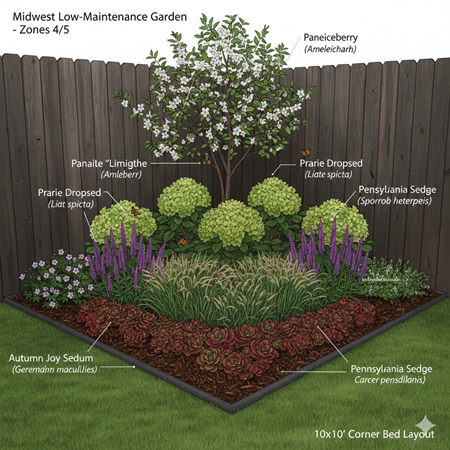
For Midwest Zones 4 and 5 (think Iowa, Illinois, Southern Wisconsin, and Minnesota), plants need to be “Midwest Tough.” They must survive -30°F winters, humid summers, and the occasional heavy clay soil.
The following selections are the gold standard for low maintenance in your region. They are perennials that don’t require staking, frequent dividing, or chemical help.
1. The “Heavy Lifters” (Shrubs & Structure)
These plants survive the harshest winters and look better with age.
- Panicle Hydrangeas (e.g., ‘Limelight’ or ‘Bobo’): Unlike the “Bigleaf” hydrangeas that often fail to bloom in the Midwest due to late frosts, Panicle hydrangeas bloom on “new wood.” They are virtually foolproof and only require one trim in late winter.
- Serviceberry (Amelanchier): A native small tree or large shrub. It gives you white flowers in spring, edible berries in summer (that birds love), and brilliant red foliage in fall. It is perfectly adapted to the Midwest’s seasonal swings.
- False Indigo (Baptisia australis): This is a “plant it and leave it for decades” species. It has deep taproots that make it incredibly drought-tolerant once established. It looks like a shrub with blue sweet-pea flowers, but it’s a perennial that stays tidy without pruning.
2. High-Impact, Low-Effort Perennials
These are the “workhorses” that will fill your garden beds and suppress weeds.
- Blazing Star (Liatris spicata): These vertical purple spikes are striking and native to the Midwest prairies. They are butterfly magnets and thrive in the heavy clay soil common in Zones 4 and 5.
- Prairie Dropseed (Sporobolus heterolepis): The most elegant native grass. It grows in a tidy, fountain-like mound. In late summer, it emits a faint scent often described as buttered popcorn or coriander. It never gets “messy.”
- Autumn Joy Sedum: A classic for a reason. It is a succulent that starts green, turns pink in late summer, and transitions to a deep rust in autumn. It holds its shape even under heavy snow, providing winter interest.
3. The “Ground-Huggers” (Lawn Alternatives)
For those shady spots under maples or oaks where grass goes to die, try these:
- Pennsylvania Sedge (Carex pensylvanica): It looks like fine-textured grass but only grows about 6 inches tall and loves shade. You never have to mow it.
- Wild Geranium (Geranium maculatum): A tough native that forms a dense mound of foliage and lavender flowers. It’s excellent at “knitting” together to prevent weeds from popping up.
Your 5-Year “Slow & Steady” Transition Plan
This strategy spreads the cost and labor out, making the project manageable for a busy schedule.
| Year | Focus Area | Action Step |
| Year 1 | The Perimeter | Create 3-foot-wide mulch beds around the edge of your lawn. Plant your “Heavy Lifters” (Hydrangeas/Serviceberry). |
| Year 2 | The Hardest Mowing Spot | Identify a steep hill or a tight corner. Remove the grass and install Prairie Dropseed and Sedum. |
| Year 3 | Irrigation & Edging | Install a simple DIY drip kit for your new beds and put in permanent metal or stone edging to stop grass “creep.” |
| Year 4 | The “Color Fill” | Add your pollinators like Liatris and Baptisia into the gaps between your Year 1 shrubs. |
| Year 5 | The Final Shrink | Expand a patio or add a fire pit area with gravel to further reduce the remaining “must-mow” lawn. |
A Pro-Tip for Zone 4/5:
Don’t clean up in the fall! In the Midwest, leaving your dead perennial stalks standing until spring serves two purposes:
- It protects the “crown” of the plant from the extreme freeze-thaw cycles of February.
- It provides a habitat for native bees to over-winter.
This article was originally published in Tri-State Home TRENDS, a Dubuque area magazine for new homeowners, home remodelers, home builders, and related industries. Single copies are available at Dubuque area newsstands for free or click here to read the digital version of the latest issue.
Read Julien’s Journal, CHOICES For Fifty Plus and Tri-State Home TRENDS from the Comfort of Your Home!
Click Here or call 563.557.7571 for convenient delivery to your home or business by mail of all three magazines for one low subscription price.
Comment here