

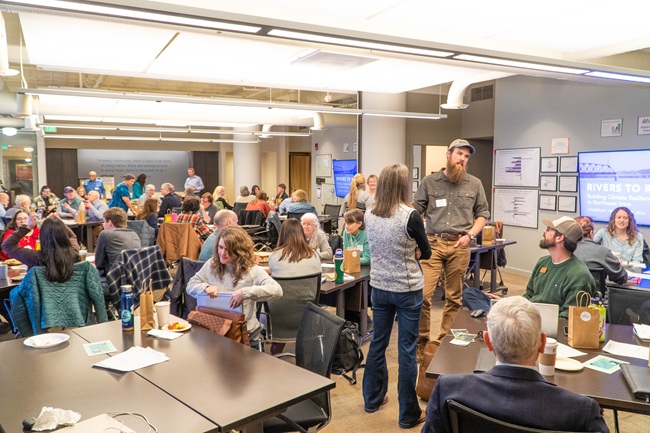
A first-of-its-kind summit in Dubuque brought together more than 50 organizations working on environmental issues to form new partnerships and build capacity for impact.
Kaytlan Moeller is so passionate about environmental conservation that she has built a career around it. As outreach coordinator for Dubuque County Conservation, she builds awareness about issues impacting the environment and services that the organization offers to address those issues, such as the Mowing to Monarchs program.
“Dubuque County Conservation is one of those hidden gems. Not a lot of people know about us,” she says. “I want to make connections with other organizations and find more points of collaboration to build a stronger bridge between what we offer and the needs in the community.”
That’s why she attended the Community Foundation of Greater Dubuque’s February 19 summit, Rivers to Ridges: Building Climate Resilience in Northeast Iowa. This first-of-its-kind event, hosted in partnership with the Iowa Environmental Council, brought together more than 50 individuals from organizations working in areas like conservation, education and public policy and representing all seven counties in the Foundation’s region: Dubuque, Allamakee, Clayton, Delaware, Jones, Jackson and Clinton.
It was an opportunity for community leaders from the region who are passionate about sustainability, conservation and environmental issues to learn about one another’s work and strengthen relationships.
“Imagine a network where we share resources about, support each other’s advocacy work, and deliver a common agenda,” Nancy Van Milligen, the Community Foundation’s president and CEO, told the audience. The goal, she said, is to build a network that can leverage collective ingenuity and secure more funding to help tackle Northeast Iowa’s most pressing issues, including soil and water quality, energy efficiency, and preservation of natural ecosystems. Doing so can improve public health, strengthen the local economy, and save individual households money.
While discussions touched on specific issues, such as correlation between cancer rates and the environment, energy efficiency and regenerative agriculture, the theme connecting all these topics was “partnerships.”
“Collaboration is where the magic is going to happen,” said Jason Neises, the Foundation’s community development officer.
The event’s facilitator, Dave Lyons, a strategic initiatives consultant who works with the Community Foundation and Greater Dubuque Development Corp., gave an example of how organizations working on education and advocacy around water quality will need to build relationships with a particular key audience to drive policy and implement new practices to make improvements.
“Iowa has the least amount of public lands of almost all states,” Lyons said. “It we are talking about changing anything, it has to involve the private sector, like landowners and farmers.”
If “collaboration” drove the conversations, the question of “funding” was consistently an underlying concern for most attendees.
The Midwest – especially Great Plains states – receives less funding from national organizations than any other U.S. region. When it comes to environmental issues specifically, Iowa receives just 0.2% of national funding.
Capacity and connections are two major reasons. Unlike states such as Nebraska, home to the Buffett Foundation, or Arkansas, home to the Walton Family Foundation, Iowa lacks a major family foundation with national reach, leaving local and regional foundations to compete for national funding on their own.
“Collaboration: It’s the only way we are going to be able to capture some of the larger grants out there,” Van Milligen said.
As a network, the organizations represented at Rivers to Ridges can pool their resources and partner with the Community Foundation, which has a long history of securing national funding that it can grant to local groups.
“Rather than individual organizations applying for funding, the Foundation can work with all of you to put together a comprehensive and cohesive proposal to take to potential funders,” Lyons told the audience.
As the Rivers to Ridges event ended, participants agreed that future gatherings will be key to building the network and capacity necessary to make an impact. The Community Foundation plans to host regular convenings, while participating organizations will form working groups around the top environmental issues.
“This is about building relationships first,” Van Milligen said. “Results will follow.”
To get involved in this work, contact the Community Foundation of Greater Dubuque at 563-588-2700 or office@dbqfoundation.org.
This article is made possible by a partnership between Julien’s Journal and the Community Foundation of Greater Dubuque.
Read Julien’s Journal, CHOICES For Fifty Plus and Tri-State Home TRENDS from the Comfort of Your Home!
Click Here or call 563.557.7571 to subscribe for convenient delivery to your home or business by mail of all three magazines for one low subscription price.
Comment here