
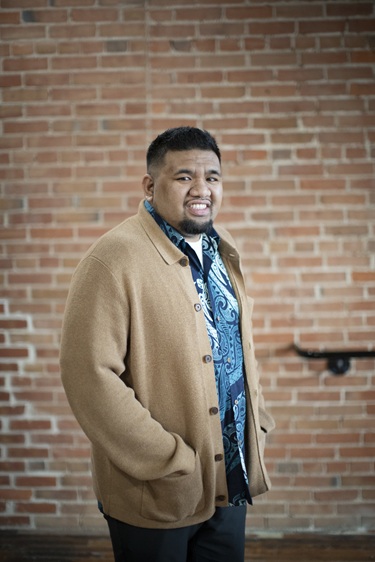
Medical appointments can be nerve-wracking – even more so when you are worried you might not understand the language your doctor or nurse is speaking. That’s where someone like Dustin Alfred comes in.
Dustin is one of over 20 interpreters and translators in the Dubuque region who work with medical providers, as well as businesses and organizations, to communicate and build trusting relationships with people whose first language is not English. These interpreters are helping meet needs identified in the Community Foundation’s 2023 Immigration Community Assessment – needs that were specifically cited by members of the region’s growing foreign-born communities and the people who work to support them.
Dustin, for example, speaks the native language of Dubuque’s growing Marshallese community, while other interpreters are fluent in Spanish.
“At a medical clinic, we work to build trust with the community,” says Dustin, who moved to Dubuque with his family from the Marshall Islands when he was 10. “People come for more than just medical care. It’s where they come if they need anything, from transportation to housing to a job.”
People from the Marshall Islands represent one of numerous growing communities of foreign-born residents in Dubuque who have helped make the region’s population the most racially and ethnically diverse in its history. Other growing communities are made up of people from Latin American countries like Guatemala and Venezuela.
While these expanding communities have brought much cultural and economic vibrancy to the region, they also face barriers to opportunities that would help them to thrive for generations to come.
Recognizing demographic trends, a group of local religious sisters partnered with the Community Foundation to assess the strengths and needs of immigrants in the region. The goal was to close service gaps and connect people with resources like jobs and translation services.
“Our Immigration Community Assessment has provided insights that service providers and nonprofits previously never had,” says Alex Baum, the Foundation’s director of advocacy, data and learning, who facilitated the assessment.
One of the most significant outcomes has been formation of the Better Together Committee, a group of about 90 leaders from nonprofits, civic agencies and immigrant communities working collaboratively to tackle the priorities outlined in the assessment, including the need for certified medical interpreters.
In addition to pursuing his certification, Dustin also serves on the committee. He acts as a connector with Dubuque’s Marshallese community, providing cultural context for issues like health care. For example, he explains that in the Marshall Islands, people typically don’t see a doctor for regular exams, instead going only when they are sick or hurt, and the cultural norm is for patients to only work with interpreters of their same gender.
Having leaders like Dustin working together to address community issues has meant more people can access the resources they need. In one case, Dustin interpreted for a Marshallese patient who was diagnosed with an unforeseen condition and was able to receive critical follow-up care.
“He said he really loved Dubuque and his clinic for having an interpreter,” Dustin says. “It gave him peace of mind to trust us.”
If you would like to connect with a local Spanish- or Marshallese-speaking interpreter, please visit understandingmattersdbq.org or dubuquecountyiowa.gov/723/interpreters. If you have questions, please contact Alex Baum at 563-588-2700 or alex@dbqfoundation.org.
This article is made possible by a partnership between Julien’s Journal and the Community Foundation of Greater Dubuque.
Read Julien’s Journal, CHOICES For Fifty Plus and Tri-State Home TRENDS from the Comfort of Your Home!
Click Here or call 563.557.7571 to subscribe for convenient delivery to your home or business by mail of all three magazines for one low subscription price.
Comment here