

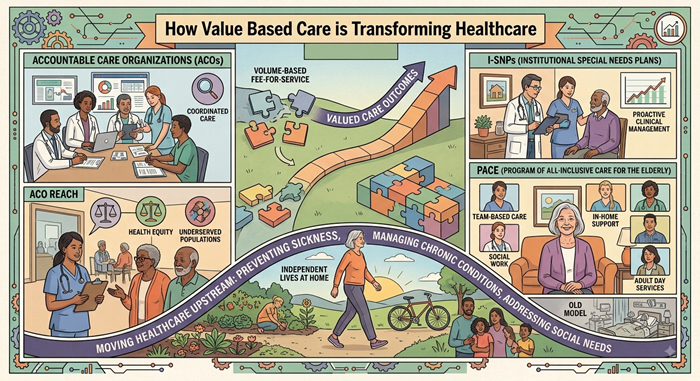
Value-based care is transforming healthcare by shifting the focus from the volume of services delivered to the quality of outcomes achieved. Rather than rewarding healthcare providers simply for delivering more tests, procedures, or hospital visits, value-based care emphasizes keeping people healthier, improving quality of life, coordinating services, and preventing avoidable complications. For older adults, this approach is particularly important because their healthcare needs are often complex and may involve multiple providers, medications, caregivers, and community-based services.
Several value-based care models are designed to address these challenges. Accountable Care Organizations (ACOs) bring together physicians, hospitals, specialists, and other healthcare providers to coordinate care and improve outcomes for Medicare beneficiaries. Under models such as the Medicare Shared Savings Program (MSSP), participating organizations are encouraged to improve quality while reducing unnecessary healthcare spending. When organizations successfully achieve better outcomes and lower costs, they may share the savings.
ACO REACH is another Medicare value-based model that focuses on coordinated, person-centered care while placing greater emphasis on health equity and serving underserved populations. These models encourage providers to look beyond individual medical visits and consider the complete picture of an older adult’s health and social needs.
For older adults with more complex needs, Institutional Special Needs Plans (I-SNPs) provide another important model. I-SNPs are designed for individuals who require nursing-home-level care and emphasize coordinated services, proactive clinical management, and early identification of changes in condition. By having healthcare professionals closely connected to the care setting, problems can often be addressed before they require an emergency department visit or hospitalization.
The Program of All-Inclusive Care for the Elderly (PACE) is one of the most comprehensive examples of value-based care. PACE enables eligible older adults who meet nursing-home-level care requirements to remain safely in their homes and communities whenever possible. An interdisciplinary team—including physicians, nurses, therapists, social workers, dietitians, pharmacists, and other specialists—works together to create and continually adjust an individualized care plan. PACE integrates primary and specialty medical care, rehabilitation, prescription medications, transportation, adult day services, meals, social services, and caregiver support into one coordinated program.
Other value-based approaches include bundled payment models, which provide a single payment for an episode of care and encourage providers to work together across settings, and patient-centered medical homes, which emphasize primary care, prevention, chronic disease management, and coordination among providers.
Across these models, the common goal is clear: move healthcare upstream. Instead of waiting for an older adult to become sick enough to require hospitalization, value-based care encourages providers and care teams to identify risks early, manage chronic conditions, support caregivers, and address social needs that can affect health.
By prioritizing prevention, coordination, independence, and person-centered care, value-based models are helping redefine senior healthcare. They demonstrate that better outcomes, improved quality of life, and responsible stewardship of healthcare resources can go hand in hand—creating a healthcare system that is not only focused on treating illness, but on helping older adults live healthier, more independent lives in the places they call home.
Elizabeth Kunde is the Executive Director of Strategy and Compliance at Stonehill Communities. Elizabeth has a master’s degree in health administration from the University of Iowa and has been a licensed nursing home administrator in Iowa and Wisconsin.
This article was originally published in CHOICES For Fifty Plus, a Dubuque area magazine for people that are 50 and older. Single copies are available at Dubuque area newsstands or click here to read the digital version of the latest issue.
Read Julien’s Journal, CHOICES For Fifty Plus and Tri-State Home TRENDS from the Comfort of Your Home!
Click Here or call 563.557.7571 for convenient delivery to your home or business by mail of all three magazines for one low subscription price.
Comment here