
On a Thursday morning, students at Dubuque’s Alternative Learning Center are taking part in a listening session, answering questions about their school experiences. How helpful are teachers? How do students support one another? How do students know about their academic performance?
A senior named John Fisher speaks up: “Teachers are really good at telling you how you are doing in class,” he says. “Like with Eddie, I know I can walk into his office and ask, ‘How am I doing, and he will tell me.’”
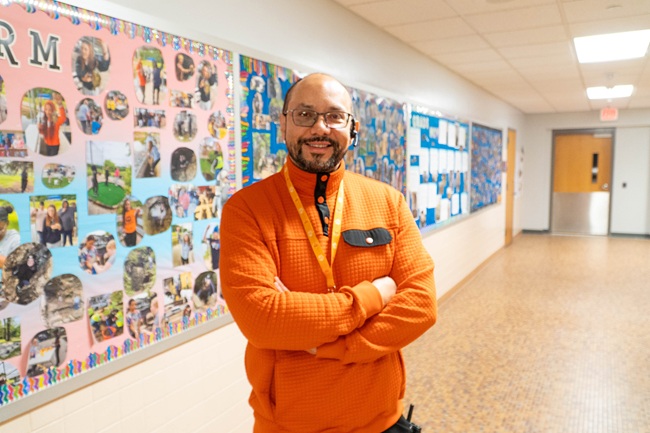
Eddie is Eddie Santiago, and he is sitting next to John. Eddie also is the school’s principal and a key player in the Community Foundation’s GRAD Partnership initiative. In his four years at the Alternative Learning Center, he has worked with Dubuque Community School District administrators to increase graduation rates at the school, which serves students who benefit from a more hands-on high school learning experience.
The GRAD Partnership provides a framework to build on that positive momentum. Through this national partnership, we work with schools in the Dubuque region to build and enhance student success systems. The goals are more engaged students, better attendance, and higher graduation rates. It’s part of our broader efforts to tackling chronic absenteeism and set students up for long-term success.
“Anything we can do to remove barriers so students can meet the goal of graduating is helpful,” Eddie says.
What sets The GRAD Partnership framework apart from traditional student success system models is that it is evidenced-based driven by data. This helps educators identify warning signs early and intervene before students fall too far behind.
“It emphasizes supportive relationships as important to academic success,” says Shirley Hosrstman, school attendance and college access coordinator. “This is not just teachers and administrators implementing a program. Students, families, and communities all have a voice in shaping solutions that work in their specific context.”
The GRAD Partnership is still in its early stages in the Dubuque region, but national data suggests what local schools can look forward to: significant declines in absenteeism and course failure rates.
Back at the Alternative Learning Center, the student listening session is wrapping up. As students stand to leave, Eddie lets them know that he brought candy, just as he promised, and the teens grab a few pieces as they walk out the door.
It’s one of those small gestures to remind them that they are supported.
This article is made possible by a partnership between Julien’s Journal and the Community Foundation of Greater Dubuque.
Read Julien’s Journal, CHOICES For Fifty Plus and Tri-State Home TRENDS from the Comfort of Your Home!
Click to subscribe or call 563.557.7571 to subscribe for convenient delivery to your home or business by mail.
Comment here