

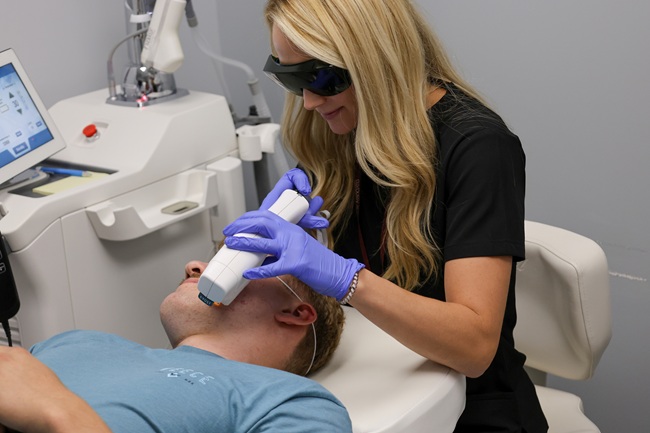
You’ve seen the ads. You’ve heard the buzzwords. Maybe you’ve even caught yourself Googling “Botox near me” and then closing the tab before you could talk yourself into it. There are many popular aesthetic treatments available right here in the Dubuque area — Botox, Broadband Light therapy, and ablative laser treatments, and many places that offer them. What are the differences?
First, a Little Framework
Before diving into specific treatments, Erin Kennedy, M.D., FACS, board-certified plastic surgeon at EK Plastic Surgery, offers a surprisingly simple way to think about facial aesthetics. “When you look at your face and you’re trying to figure out what would be the best thing to address it, I always tell people it’s like four branches of a tree,” she says. Those branches? Relax, refill, resurface, and redrape. Botox falls into the “relax” category, targeting lines caused by muscle movement. Lasers and light treatments live in the “resurface” world — improving the actual quality, tone, and texture of your skin.
Understanding which branch your concern falls under is half the battle, which is exactly why it is important to undergo a proper consultation before booking any treatment.
So, What Is Botox, Exactly?
Botox is a medication that temporarily relaxes the small muscles responsible for the creases and lines that appear when you squint, smile, or furrow your brow. Think of the lines between your eyebrows when you frown, or the crow’s feet that fan out when you laugh. Those happen because of muscle movement, and that’s precisely what Botox targets.
“If what you don’t like is because of when you do muscle movement, then relaxing those muscles is the best way to soften those lines,” says Dr. Kennedy.
It’s worth knowing that “Botox” is a brand name, but there are currently other FDA-approved neuromodulators on the market. Some take effect faster, some last longer, and different patients respond differently to each. Botox results typically last several months, though many patients start to notice some muscle movement returning around the three-to-four-month mark. The more consistently you get treated, the better things tend to go over time.
Downtime with Botox is essentially zero. “You can do this and go immediately back to work, go out, do anything you want,” says Dr. Kennedy. Just keep in mind that it takes three to five days for decreased movement to appear, and the full effect may not be realized for up to two weeks.
To read the remainder of this premium article and other premium articles in their entirety, pick up the Julien’s Journal July 2026 issue. Single issues are available in print for free at area newsstands, or you can click here to read the entire article for free in the digital version of the magazine.
Read Julien’s Journal, CHOICES For Fifty Plus and Tri-State Home TRENDS from the Comfort of Your Home!
Click to subscribe or call 563.557.7571 to subscribe for convenient delivery to your home or business by mail.
Comment here